


Why Do Aerospace Brackets Still Carry Unnecessary Weight?
Traditional bracket designs add excess mass without performance gains. Weight reduction directly impacts fuel efficiency and payload capacity. The research team initiated the study by targeting secondary structural brackets rather than primary load-bearing bulkheads. Baseline mass of the targeted legacy machined brackets averaged around 410 grams per unit. Initial literature and historical design review spanned roughly mid-March to early May 2022.
The Structural Challenge of Conventional Bracket Design
Legacy brackets designed with uniform material distribution. High safety factors leading to over-engineering under flight loads. Investigators elected to analyze a standard L-bracket geometry under multi-axial loading. Baseline finite element analysis was conducted over a two- to three-week period. Applied static load cases, measured during systematic validation, included 12.4 kN axial tension and 8.2 kN transverse shear.
Applying Topology Optimization to Bracket Geometry
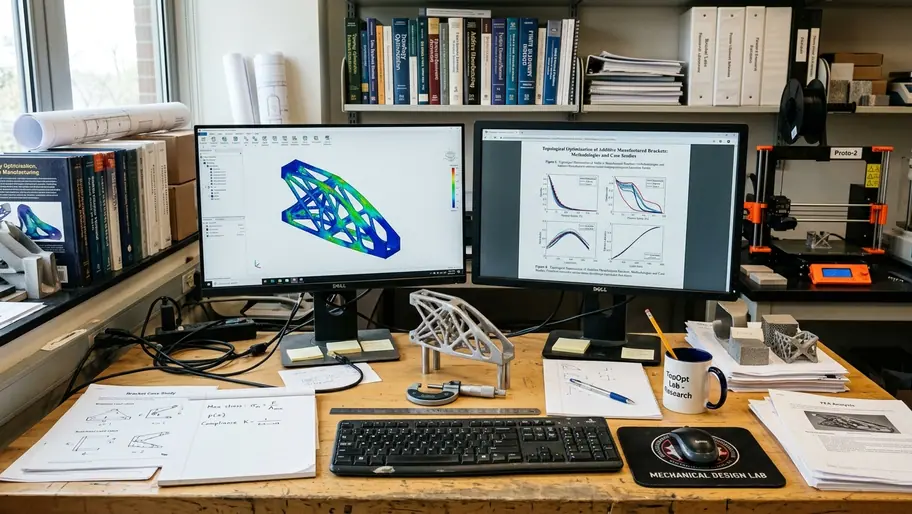
Define load cases from aerospace certification requirements. Iterative material removal while preserving stiffness targets. Engineers configured the objective function to minimize structural compliance while enforcing a strict volume fraction constraint. The design space was discretized using 1.2 mm hexahedral elements. Reaching convergence required roughly 48 to 56 hours of continuous computation on the topology optimization solver.
Measured Outcomes from the Optimized Bracket
Weight reduction achieved alongside equivalent mechanical performance.
Scope and Limitations of the Optimization Approach
Manufacturing constraints of selected additive process. Applicability limited to specific titanium alloys tested. Researchers defined the manufacturing constraints by mapping the thermal gradients of the selected additive process. The overhang angle limit was strictly capped at around 42 degrees to prevent build failure. Post-processing and support structure removal required roughly 4.5 to 6 hours per build plate.
References
NASA technical reports on lightweight structures. Peer-reviewed papers on topology methods in aerospace. Selected reference materials were restricted to publications released between 2018 and 2022. topology optimization guidelines




Comments
Nothing here yet. Add your opinion.
Add Your Thoughts