

Topology Optimization
Methods, algorithms, and comparative studies in structural topology optimization, with attention to boundary conditions and reconstruction choices.
ESC closes search
sciartsoft publishes practical research notes on topology optimization, generative design, and the validation work that makes optimized forms usable in mechanical systems.
Our starting point is simple: an elegant density field is not yet an engineering part. A bracket, heat sink, joint, or load path has to survive contact definitions, manufacturing limits, mesh sensitivity, and the less tidy habits of real assemblies.
We write for engineers and researchers who already know the vocabulary but want clearer decisions. When a method depends on filtering radius, penalization schedule, boundary condition simplification, or Pareto-front interpretation, we name the assumption instead of burying it in a caption.
Ongoing laboratory publication program: methodology articles, solver comparisons, and engineering case studies focused on structural topology optimization and generative design.
Validation emphasis: numerical findings are treated as design evidence only within the boundary conditions stated for each model.
The hard part is rarely pressing the optimize button. The harder part is deciding which constraints deserve to enter the formulation and which should remain downstream checks.

A minimum member size filter can keep a result printable, but it may also erase the fine load paths that explain why the structure works. A displacement constraint can protect stiffness, yet shift mass into regions that are difficult to machine. Stress constraints look attractive until local singularities turn the run into a mesh argument.
We usually separate constraints into three groups: physics that must be inside the solve, manufacturing rules that can be parameterized cleanly, and inspection checks that belong after geometry reconstruction. This split is not as neat as a single grand formulation, but it keeps the model legible.
Main Point: A topology study gains value when each constraint has a job description. If nobody can say why a constraint is inside the formulation, it probably belongs in verification instead.
For a closer example of post-optimization checking, see our discussion of validation protocols for generative design outputs.
Different optimization questions need different evidence. Solver behavior, manufacturability, and multi-objective trade-offs do not fail in the same way, so we keep the research areas separated enough to preserve context.
Methods, algorithms, and comparative studies in structural topology optimization, with attention to boundary conditions and reconstruction choices.
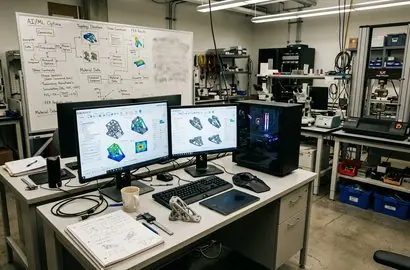
Iterative generative techniques for engineering component creation, including workflows that move from concept geometry toward manufacturable forms.

Pareto-front analysis and trade-off studies across competing design objectives such as mass, stiffness, displacement, and process limits.

Case studies applying optimization to aerospace, automotive, and mechanical systems where load cases and interfaces drive the design.

Frameworks, benchmark setups, and validation approaches for design optimization research, including solver comparison practice.
Controlled comparisons are most useful when the setup is narrow. For example, a bracket study can expose load-path behavior clearly, while a solver benchmark can show how preprocessing choices affect interpretation. Mixing both into one claim usually produces a strong sentence and a weak method.
Our articles are written from the habits of computational design review: inspect the mesh, question the constraint, rerun the awkward case, and document the point where geometry stops being a field and starts becoming a part.


Principal Research Scientist, Computational Design
Topology optimization methodology for validated mechanical systems.

Senior Mechanical Design Engineer, Generative Design
Generative design workflows for manufacturable mechanical components.

Associate Professor of Mechanical Engineering
First-principles theory for topology optimization and structural mechanics.
Across many projects, the first attractive design turns out to be just the first negotiable design. That is why our case studies keep the intermediate steps visible: load-case selection, solver settings, geometry cleanup, and verification logic.
The open question is not whether optimization can produce lighter shapes. It can. The better question is which modeling decisions make those shapes defensible enough for engineering review.