


What a Collapsed Front Costs the Next Design Review
What do you hand a design review committee when every single candidate in a four-objective archive returns as non-dominated? When survival sorting loses selection pressure, the optimization loop hands back a saturated population rather than a ranked shortlist. The engineering team faces an immediate penalty: resolving an unranked, non-dominated archive after a stalled review requires another 36 to 72 hours of finite element reanalysis and manual CAD reconstruction in most situations.
A typical failure leaves the program choosing between a light topology the machine shop cannot fixture and a stiff geometry that blows past the unit cost ceiling.
In production engineering applications, topology optimization rarely stops at two variables. A full four-objective formulation pairs total mass (kg) and structural compliance (N·m or mm/N) directly with estimated part cost and a composite manufacturability penalty score. Treating this four-dimensional setup like a classic two-objective mass-stiffness study turns the final archive into a passive data dump instead of an engineering decision.
Why Dominance Stops Separating Designs Past Three Objectives
Pareto dominance operates on a strict rule: one candidate design dominates another only if it performs no worse on every objective and strictly better on at least one. Across two or three criteria, that filter cuts through an evolving population efficiently. Add a fourth independent criterion, and the filter stops culling weak compromises.
The mathematical stall stems directly from physical structural conflicts. While mass and compliance pull against each other predictably, cost and manufacturability move along separate axes driven by four orthogonal structural factors:
- Alloy grade selection
- Machining setup count
- Minimum member strut diameter
- Sacrificial support material volume
Because these physical drivers decouple from raw elastic stiffness, almost every generated topology finds at least one axis where it beats its neighbors. During generation-to-generation survival sorting across 150 to 300 evolutionary generations, standard Pareto dominance tests fail to eliminate topologies that trade off minimum member thickness or 5-axis tool access against raw structural compliance. Secondary crowding-distance operators then take over, pushing points toward extreme single-objective corners while leaving the central compromise region sparse and unrefined.
Turning Four Objectives Into Weighted Subproblems
Decomposition restores selection pressure by translating the multi-objective space into a set of coupled scalar problems. Each weight vector defines a distinct subproblem, and survival selection operates inside that vector's local neighborhood rather than across the entire non-dominated archive at once.
- Normalize the raw objective outputs: Mass in kilograms, structural compliance in mm/N, estimated cost in currency, and a unitless manufacturability penalty are incommensurable. When raw objective outputs feed into a scalarizer without first mapping onto a common unitless interval, the numerically largest unit dominates every subproblem regardless of the assigned weight vector—allowing an unnormalized currency cost term to swamp mass and compliance and overwrite high-stiffness topologies with cheap, flexible brackets.
- Recalibrate the bounds dynamically: Execute dynamic nadir and ideal point recalibration every 10 to 20 generations so compliance and currency cost estimates stay locked to a
[0, 1]scale as the front shifts. - Select a non-convex scalarizer: Linear weighted-sum formulations miss non-convex stretches of a structural front, which appear whenever a minimum feature size cutoff abruptly truncates the mass-stiffness trade-off. Tchebycheff and penalty-based boundary intersection formulations reach into those concave regions and preserve valid intermediate geometries.
- Restrict neighborhood replacement: Limit replacement to the 5 to 12 closest weight vectors in Euclidean direction space so an inexpensive, high-compliance geometry cannot overwrite the stiff end of the archive.
Anchoring the Population to Reference Points the Review Can Use
Reference-point selection replaces raw dominance sorting with spatial association. The algorithm links each candidate topology to its nearest reference direction in objective space, and survival favors the candidate that best represents that specific direction. For a four-objective formulation, a two-layer simplex-lattice direction layout combines an outer boundary grid with an inner contracted layer to prevent mid-front sparsity across the four-dimensional space.
Simplex Pruning Under Manufacturing Cutoffs
Minimum-member-size and 5-axis tool-access cutoffs carve disconnected holes into a four-objective front. Pruning unassociated reference directions after 40 to 60 generations of feasibility enforcement prevents the solver from stranding fixed simplex vectors in geometrically impossible voids.
A uniform lattice wastes computational effort on extreme corners that no review board will approve. By concentrating reference directions inside the acceptable bounding box—bounded by minimum stiffness, maximum part cost, and the shop's manufacturability threshold—the method packs topological diversity directly into the deliverable design region. When an aggressive overhang constraint empties an internal niche, dropping the dead vector shifts survival capacity back toward buildable struts. How much boundary coverage should an analyst sacrifice when tightening that target box before the initial finite element mesh even runs?
Reading Crossings on a Parallel-Coordinate Front
A three-dimensional scatter plot fails a four-objective review. It plots mass, compliance, and cost cleanly, while hiding the manufacturability index that ultimately kills the candidate on the shop floor.
Replacing the 3D scatter plot with a four-axis parallel-coordinate view puts the full structural trade-off on a single plane. Every vertical axis maps to one objective normalized to [0, 1] with identical improvement polarity oriented toward minimization, and each retained topology traces a single polyline across all four axes. When high archive density blurs individual traces, pairing the plot with a direction-sorted objective heatmap restores visual separation.
Under normal use, this layout allows an engineer to screen an archive of 80 to 200 non-dominated topologies down to a visible shortlist within a 45-to-60-minute pre-review triage session. Three visual signatures guide the eye:
- Steep X-crossings between compliance and cost: These intersections confirm active trade-offs where stiffer load paths demand higher material volume or longer cycle times.
- Horizontal polyline bundles: Tightly grouped flat segments clamped at the same height on the manufacturability axis expose a single shop-floor tooling limit halting further topological refinement.
- Isolated vertical spikes: A polyline that drops low on mass and compliance but shoots upward on the fourth axis flags a geometry that achieved stiffness by violating minimum member thickness.
Three Polylines, One Bracket for the Review
The pre-review triage for a four-objective mounting bracket optimization—evaluating mass, linear elastic compliance, material-plus-machining cost, and a manufacturability penalty driven by minimum member thickness and cutter access—narrows to a final 15-minute inspection. Filtering the parallel-coordinate plot to retain only reference directions inside the stiffness floor and the cost cap strips the screen down to three candidate polylines.
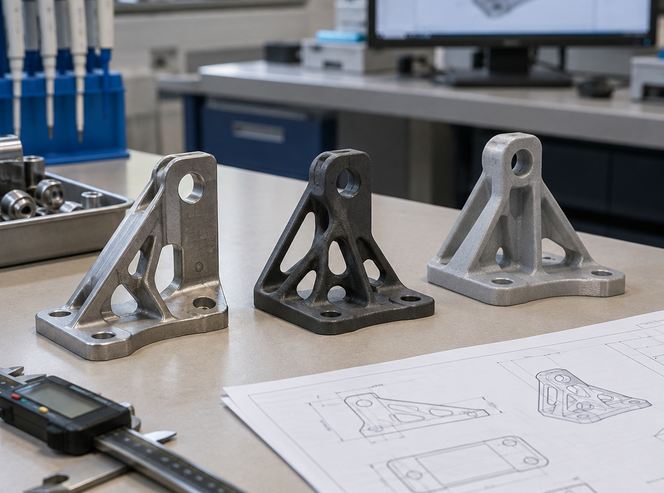
On the monitor, two of the traces dip attractively low on the mass and compliance axes, then angle sharply upward to spike on the manufacturability axis where thin inner ribs pinch off 5-axis cutter clearance. You click those two traces off. One polyline remains flat and low across all four verticals. On the steel inspection table beside your keyboard sits the verification piece from that exact reference vector: an aluminum bracket with clean tool runout along its organic ribs and a thick, flat clamped boss ready for the machinist's caliper.





Comments
Nothing here yet. Add your opinion.
Add Your Thoughts